
A report by Consumer Intelligence Research Partners (CIRP) presents very positive data on sales of the larger iPhone 12 models, but on the other hand, the smaller sibling in the line, the iPhone 12 Mini model, has not been very successful.
iPhone 12 models accounted for 76% of sales in this line. Apple during the October-November period following their launches. The standard 12-inch iPhone 6,1 took the largest share of new iPhone sales in the United States, taking up 27% of the total. The iPhone 12 Pro and iPhone 12 Pro Max models took around 20% of sales, not far behind the leading model.
In 2019, the situation was a little different regarding sales of the iPhone 11, which reached 69% of the total related to the flagship smartphone. Apple in the US. Of that share, the standard iPhone 11 got 39%, easily surpassing the 30% achieved by its iPhone 11 Pro and 11 Pro Max models combined.
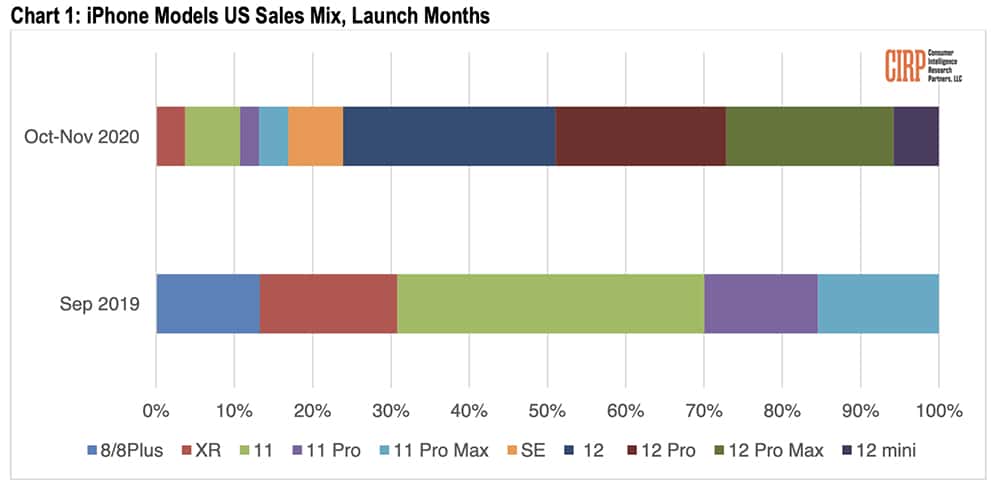
As to 12 iPhone Mini, its presence in sales was very minimal, compared to the larger models. With just 6% of total iPhone 12 sales during October and November 2020, the 5,4-inch device seems far from achieving the success expected by the model's most optimistic users.
Higher prices may lead to lower sales
Analyst Mike Levin, partner and co-founder of CIRP, speculates that this may be due to selling prices. In converted values, without added fees and taxes, the iPhone 12 Mini, despite having all the features found in the larger versions, can be found for around R$3.694 in the US. The iPhone XR and iPhone 11 cost R$2.637 and R$3.166 respectively.
The differences in prices are very significant. And if we consider that the 2nd generation iPhone SE, launched in April 2020, is found for R$2.108 (in converted values, without taxes and fees), an improvement in sales of the iPhone 12 Mini may not be so easy to achieve if prices are not reduced (which is unlikely).
Through which channels you reach those people, classic and out of the box. 9 to 5 Mac